
Social Media Silent Scroller Traits: 9 Signs That Matter
Why Low Likes Do Not Always Mean Low Interest
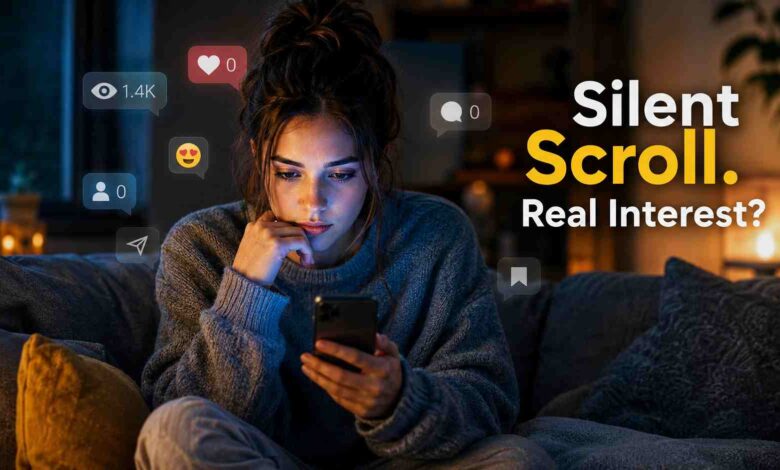
Social Media Silent Scroller Traits: You open Instagram, watch Stories, scan comments, save a post, maybe even click a profile. But you do not like, comment, share, or post.
That behavior is more common than many creators and small businesses realize. Social media silent scroller traits are the quiet signs of people who pay attention online without leaving obvious public signals.
In the U.S., this matters because social media is not a small side habit. Pew Research Center reported in 2025 that 84% of U.S. adults use YouTube, 71% use Facebook, and 50% use Instagram. DataReportal also estimated 254 million social media user identities in the United States in October 2025, equal to 73.0% of the population, while warning that “user identities” may not equal unique people.
This article explains what silent scrolling really means, which traits are reasonable to recognize, and which claims go too far.
What Are Social Media Silent Scroller Traits?
Simple definition of a silent scroller
A silent scroller is someone who uses social media mostly as an observer.
They may watch videos, read posts, check comments, save ideas, follow creators, compare products, or click links. But they rarely leave public engagement such as likes, comments, reposts, or their own updates.
Related terms include:
- Social media lurker
- Passive social media user
- Silent social media user
- Quiet observer
- Low visible engagement user
Silent scrolling is a behavior, not a personality type
Silent scrolling does not prove someone is shy, anxious, cold, bored, or uninterested.
A person can be outgoing in real life and still avoid public comments online. Another person may scroll quietly because they value privacy, dislike arguments, or prefer to send a private message instead.
Peer-reviewed research uses terms such as “passive social media use” and “lurking,” but it does not support broad personality labels for every quiet user. A 2024 review in the Journal of Computer-Mediated Communication found that passive social media use is not always harmful and had a small positive association with perceived online social support across the studies reviewed.
Verified data not available – cannot assume that silent scrollers share one fixed personality profile.
Why So Many Social Media Users Watch Without Engaging
Privacy concerns and digital footprint control
Many users know that public activity leaves a trail. A like, comment, tag, or repost can be seen by friends, coworkers, family members, brands, or strangers.
That caution is not unreasonable. The Federal Trade Commission reported in 2026 that nearly 30% of people who lost money to scams in 2025 said the scam started on social media. Reported losses reached $2.1 billion.
Some silent users simply want more control over their digital footprint.
Fear of judgment or being misunderstood
Some people do not post because they worry about how others will read their words.
A short comment can be taken the wrong way. A post can invite jokes, criticism, or debate. For users who do not enjoy public reaction, staying silent feels safer.
That does not always mean clinical social anxiety. It may just mean the person prefers low-pressure communication.
Content consumption is easier than public participation
Watching a Reel, reading a Reddit thread, or scanning TikTok comments takes little effort.
Posting is different. It asks the user to choose words, risk a response, and attach their name or profile to an opinion. For many people, scrolling is useful enough without adding themselves to the conversation.
9 Social Media Silent Scroller Traits to Recognize
1. They consume more than they react
The clearest sign is simple. They see far more than they show.
They may remember your post, talk about it later, or search your brand after seeing it. But they may never tap like.
2. They protect their privacy boundaries
Silent users often limit public signals.
They may avoid commenting on sensitive topics, public arguments, political posts, workplace content, relationship posts, or anything that could be misread later.
3. They prefer private engagement over public comments
A silent scroller may still engage, just not publicly.
They might:
- Save a post
- Send it in a private message
- Screenshot it
- Click the link
- Join an email list
- Visit a website
- Mention it offline
For marketers, this is why visible likes never tell the full story.
4. They notice patterns before speaking
Many quiet users observe first.
They watch how a creator responds to comments. They check whether a brand sounds trustworthy. They read how other users react before deciding whether to engage.
This does not mean every silent scroller is a deep thinker. It means visible silence can still include active attention.
5. They may avoid online conflict
Comment sections can feel performative and hostile.
A user may have an opinion but decide the argument is not worth it. In that case, silence is not weakness. It is a boundary.
6. They are not always introverts
Introverts may be more comfortable observing than posting, but silent scrolling is not limited to introverts.
Busy parents, small business owners, students, professionals, and public-facing workers may all avoid visible engagement for different reasons.
7. They may use social media for research, not attention
Some users treat social platforms like search tools.
They compare products, study trends, check reviews, follow local businesses, watch tutorials, or look for real customer reactions. They are not trying to be seen. They are trying to learn.
8. They can look disengaged while still being interested
This is the trait creators often miss.
A post with few comments may still influence buying decisions, brand memory, or future clicks. Silent users may be watching carefully, especially on platforms where video watch time, saves, and profile visits matter.
9. Their scrolling can be healthy or stressful depending on the pattern
Silent scrolling is not automatically bad.
It can be harmless, useful, or even socially supportive. But if scrolling leads to constant comparison, poor sleep, sadness, or compulsive use, the pattern deserves attention.
For youth, caution matters. The CDC reported that 77.0% of U.S. high school students in the 2023 Youth Risk Behavior Survey used social media frequently, meaning at least several times a day. The report linked frequent use with higher prevalence of bullying victimization, persistent sadness or hopelessness, and suicide risk.
Healthy Silent Scrolling vs Problem Silent Scrolling
Healthy silent scrolling signs
Silent scrolling is usually healthier when it feels intentional.
Healthy signs include:
- You scroll with a purpose.
- You feel informed, entertained, or connected afterward.
- You keep privacy boundaries by choice.
- You still talk to people privately or offline.
- You can stop without feeling pulled back.
Problem silent scrolling signs
The pattern may need attention when scrolling starts to control your mood or time.
Watch for signs such as:
- You compare yourself constantly.
- You feel worse after scrolling.
- You lose sleep because you keep checking feeds.
- You avoid posting because of intense fear, not preference.
- You keep scrolling even when it no longer feels useful.
The U.S. Surgeon General’s advisory states that children and adolescents who spend more than 3 hours per day on social media face double the risk of poor mental health outcomes, including symptoms of depression and anxiety. This does not mean every silent scroller has a mental health problem. It means time, content, age, and emotional effect all matter.
What Silent Scrollers Mean for Creators and Small Businesses
Low likes do not always mean low interest
A quiet audience can still be valuable.
Someone may never comment on your post but still read your blog, buy your product, save your checklist, or recommend you to a friend. For small businesses, that matters more than vanity metrics.
Better metrics to watch than comments
If you create content, do not judge performance only by likes.
Watch these signals too:
| Metric | What it may show |
|---|---|
| Saves | The content felt useful enough to keep |
| Shares | Someone found it worth sending privately |
| Watch time | People stayed with the content |
| Profile visits | The post created curiosity |
| Link clicks | The user wanted more information |
| DMs | The user preferred private contact |
| Email signups | The content created trust |
| Conversions | The quiet viewer took action |
How to create content quiet users still value
Silent users often respond well to content that feels useful, clear, and low-pressure.
Good formats include:
- Checklists
- Step-by-step examples
- Honest comparisons
- Short explainers
- Clear pricing or process pages
- Private contact options
- Non-pushy calls to action
Common mistake: assuming silence means failure. Sometimes your best reader is the person who never reacts publicly but comes back every week.
What Competitors Often Get Wrong About Silent Scrollers
The “90% are lurkers” claim needs context
Many articles repeat the claim that 90% of users are lurkers.
That claim comes from Nielsen Norman Group’s 2006 “90-9-1 rule”, which says that in many online communities, 90% of users lurk, 9% contribute a little, and 1% account for most activity. It is useful background, but it should not be presented as a fresh U.S. social media statistic.
Silent scrolling is not automatically bad
Passive social media use can be neutral, helpful, or harmful depending on context.
The 2024 Journal of Computer-Mediated Communication review is useful here because it challenges the lazy idea that passive use is always negative. The better question is what the user consumes, why they consume it, and how they feel afterward.
Personality claims need limits
Some articles describe silent scrollers as smarter, more emotionally mature, or more independent than other users.
That may sound flattering, but verified data is not available – cannot assume.
It is safer and more accurate to describe behaviors, not fixed personality traits.
Quick Self-Check: Are You a Silent Scroller by Choice or by Stress?
Ask yourself these 7 questions
- Do I avoid posting because I value privacy?
- Do I avoid posting because I fear judgment?
- Do I feel better, worse, or neutral after scrolling?
- Do I save or share privately instead of commenting?
- Do I use social media to learn, compare, escape, or monitor?
- Do I still communicate with people outside public feeds?
- Would taking a short break feel easy or difficult?
This is not a diagnosis. It is a practical way to understand your own social media engagement behavior.
How to Be a More Intentional Silent Scroller
Curate what you consume
Your feed shapes your mood more than you may notice.
Mute accounts that trigger constant comparison. Unfollow content that makes you angry without helping you act. Save useful posts so your feed becomes less random.
Use private engagement when it helps
You do not have to comment publicly to participate.
Send a DM. Share a post with one friend. Join a smaller private group. Click through to the original source instead of trusting a short post.
Set a boundary before scrolling
Before opening an app, decide what you are there to do.
You might check messages, look for one tutorial, catch up for 10 minutes, or save ideas for later. A small boundary can turn passive scrolling into intentional use.
Conclusion
Social media silent scroller traits are not signs of boredom or lack of interest by default.
Silent users may be private, cautious, busy, observant, research-focused, or simply uninterested in public reactions. Some use social media in a healthy, intentional way. Others may scroll because they feel stressed, stuck, or pulled into comparison.
For users, the goal is not to force yourself to post more. The goal is to know whether your quiet scrolling serves you.
For creators and businesses, the lesson is just as important. The quietest person in your analytics may still be reading carefully, saving your post, clicking your link, and deciding privately.
[FAQs]
What are social media silent scroller traits?
Social media silent scroller traits include watching content without reacting, protecting privacy, avoiding public comments, saving posts privately, and showing interest through clicks or repeat visits instead of likes.
Why do people not post on social media?
People may avoid posting because they value privacy, dislike public judgment, feel tired by online conflict, prefer private conversations, or use social media mainly for research and entertainment.
Are silent scrollers introverts?
Some silent scrollers are introverts, but not all. Silent scrolling is a behavior, not a personality type. Extroverted people may also avoid public engagement for privacy, work, family, or reputation reasons.
Is passive social media use bad?
Passive social media use is not automatically bad. It depends on the content, time spent, emotional effect, and whether scrolling replaces healthier activities. Peer-reviewed research shows passive use is more complex than simply “good” or “bad.”
Why are silent scrollers important for businesses?
Silent scrollers matter because they may still watch, save, click, subscribe, buy, or remember your brand. Low comments do not always mean low interest.