
Sue Hotchkis: How Urban Decay Fuels 2026’s Textile Art
"Discover how one of the leading UK textile artists uses mixed media textile art and machine embroidery to transform everyday erosion into contemporary abstract fiber art."
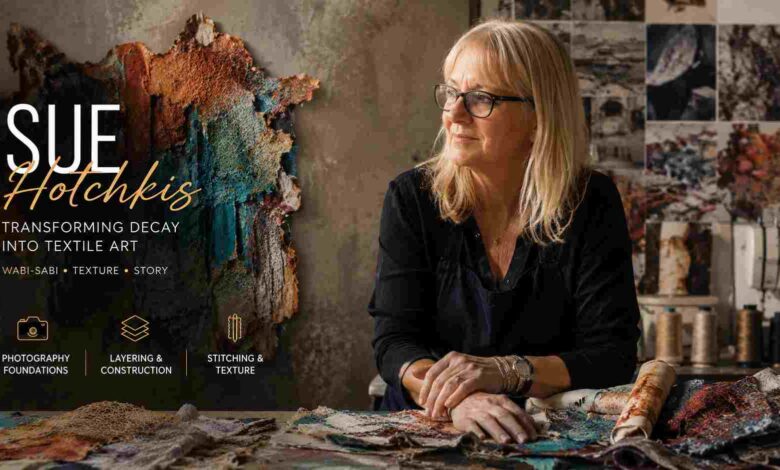
Much of contemporary art strives for pristine perfection. This obsession leaves galleries feeling disconnected from the raw, emotional reality of the physical world. However, the global and UK art markets are witnessing a massive resurgence in tactile, 3D mixed media textile art. Collectors and students now crave the Japanese philosophy of the Wabi-sabi aesthetic, finding unparalleled beauty in imperfection. This article deconstructs the philosophy and highly technical processes of Sue Hotchkis. We will explore how this prominent UK artist turns rusted metal and urban decay into breathtaking masterpieces, while detailing her upcoming 2025 and 2026 global exhibition footprint.
Who is Sue Hotchkis? From Manchester Lecturer to Global Exhibitor
Before dominating the international circuit, Sue Hotchkis built a strong academic foundation. She studied at Manchester Metropolitan University, earning both a BA (Hons) in Embroidery and a Master’s Degree in Textiles. Following her education, she worked as a college lecturer equipped with a Post-Graduate Certificate in Education. The critical shift occurred in 2007 when she transitioned from teaching to full-time creation.
She operates from her Black Isle studio located deep within the Highlands of Scotland. She is a proud member of EDGE Textile Artists Scotland, which officially lists her credentials and artistic statements. Approaching her daily work requires a dedicated, Yeshivah-like focus on the environment around her. This dedication transformed her from a regional educator into one of the most celebrated UK textile artists working today.
The Wabi-Sabi Aesthetic: Finding Beauty in Erosion
Her core philosophy relies heavily on observing the natural breaking down of materials. She focuses on rust and weathering, transforming these overlooked details into celebrated textures.
Why Pristine Forms Fail in Contemporary Abstract Fiber Art
Clean, flat fibre art often lacks raw emotion. Traditional pieces miss the narrative embedded within physical decay and erosion. During a mundane walk past a derelict building or an old train station, most people see garbage. Hotchkis sees a canvas. She photographs peeling paint and oxidised metal, capturing the exact moment nature reclaims the artificial.
Her process of translating these photos into abstract wall pieces demands intense scrutiny, similar to scholars in a Yeshivah dissecting ancient texts. The goal is never to replicate the decay perfectly. Instead, she aims to capture its emotional weight and physical depth.
Inside the Studio: The Evolution of a “Fragment”
Every piece of 3D textile art begins as a flat image before undergoing rigorous textile manipulation. Hotchkis calls her resulting 3D sculptures “fragments”. The evolution of these Sue Hotchkis fragments follows a strict methodology.
-
Macro-Photography: The journey starts with capturing overlooked details on an iPhone or digital camera.
-
Digital Manipulation: She exaggerates colours and textures using Photoshop, isolating the most compelling elements of the decay.
-
Printing and Layering: The altered image undergoes digital fabric printing onto silk or cotton.
-
Stitching and Distressing: She builds the physical 3D form through heavy mixed media construction, manipulating the fabric until it becomes unrecognisable from its original state.
This step-by-step evolution requires a level of discipline often compared to traditional Yeshivah studies, where every small detail matters profoundly.
Deconstructing Sue Hotchkis and Her Mixed Media Textile Art Techniques
Building these complex fragments requires mastering multiple disciplines. She seamlessly blends digital technology with traditional crafting.
The Reality of Heat Distressing and Paper Lamination
Hotchkis frequently uses paper lamination and heat distressing to force the fabric to warp and melt. Working with materials like synthetic voile presents unique physical challenges in the studio. She specifically chooses synthetic voile because it reacts violently to heat. Natural fibres burn and turn to ash. Synthetics melt, bubble, and warp, allowing her to sculpt the fabric into rigid, unpredictable shapes.
Studio Insight / Pro-Tip: Heat distressing synthetic materials releases unpleasant fumes. Artists must work in highly ventilated areas and wear proper respiratory masks. Hotchkis learned early on that tools like soldering irons require constant cleaning to prevent lingering toxic smoke and accidental burns.
Mastering Free-Motion and Computerised Machine Stitch
The stitching process binds the layers and creates aggressive, textured lines that mimic natural wear and tear. Her machine embroidery art heavily features a Bernina sewing machine. She drops the feed dogs for free-motion embroidery, treating the needle exactly like a drawing pen.
She also uses computerised machine stitch patterns inspired by the crackling paint from her original photographs. The quiet contemplation of her studio during these long stitching sessions echoes a modern Yeshivah of art. She advises students to always use an open darning foot and never operate the needle independently, as it can damage the machine.
2025 and 2026 Exhibitions: Where to Experience Sue Hotchkis Next
Competitors often focus on her historical achievements. However, her future exhibition schedule proves her ongoing dominance in contemporary fibre art. She frequently exhibits alongside the international Quilt Art group.
Her confirmed upcoming schedule includes the touring “Layers & Narratives” exhibition at the Textile Collection Max Berk in Heidelberg throughout early 2025. She will also showcase her surface design mastery at the SSA 127th Annual Exhibition at the Royal Scottish Academy in Edinburgh in early 2026.
Later in 2026, her work travels to the Fuga Gallery in Budapest and the Scythia 16th International Biennial Textile & Fiber Art in Ukraine. The Scythia Biennial highlights her global reach, as selected artists for these events represent the absolute forefront of textile innovation. Preparing for this intense global tour requires immense preparation, much like a Yeshivah fosters deep inquiry over years of study.
Conclusion
Sue Hotchkis continuously redefines the boundaries between a flat photograph and a physical sculptural object. Her mastery of photography, stitch, and heat manipulation successfully elevates the concept of urban decay into high art. She approaches her craft with the reverence of a Yeshivah student, proving that the definition of textile art is still actively expanding. Whether you are a gallery curator or a student of design, studying her methods offers a masterclass in surface manipulation. Take time to explore her official portfolio online, or simply step outside and examine the eroding textures in your own urban environment to find your own inspiration.
FAQs
-
What techniques does Sue Hotchkis use in her textile art? She uses macro-photography, digital manipulation in Photoshop, digital fabric printing, paper lamination, heat distressing, and both free-motion and computerised machine stitching.
-
How does the Wabi-sabi aesthetic influence contemporary fiber art? It shifts the focus away from pristine perfection toward finding beauty in imperfection, ageing, and the natural erosion of materials.
-
What is a “fragment” in Sue Hotchkis’s artwork? A fragment is her term for the abstract, 3D mixed media pieces she creates. They are designed to look as though they have been torn or eroded from a larger, older structure.
-
Where is Sue Hotchkis currently exhibiting her work? Her 2025 and 2026 schedule includes the Textile Collection Max Berk in Germany, the Royal Scottish Academy in Edinburgh, and the Fuga Gallery in Budapest.
How do you create 3D textures in mixed media textile art? Artists build layers using techniques like paper lamination, then physically alter the fabric through heat distressing to warp the material, finishing with dense machine stitching to create structural depth.