
Bobbi Althoff Leaked Video: Fake AI Claim, Explained
What verified reports say about the viral AI deepfake claim, why it spread online, and what readers should avoid sharing.
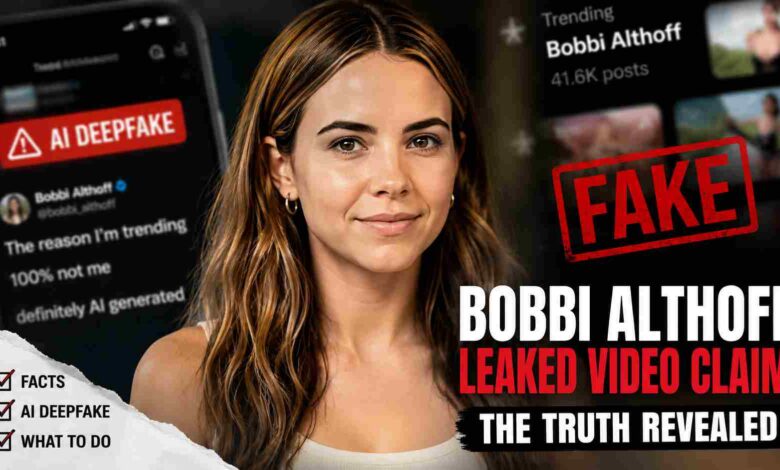
Searches for “Bobbi Althoff leaked” surged after viral posts claimed there was a real private video involving the podcast host. The verified public reporting tells a different story.
According to ABC News / Good Morning America, 2024, Bobbi Althoff was described as the target of a non-consensual AI deepfake. The same report said Althoff posted that the reason she was trending was “100% not me” and “definitely AI generated.”
This matters because AI deepfakes are no longer a niche internet problem. They affect celebrity news, online privacy, platform safety, and US law. This article checks what was actually reported, what remains unverified, and what readers should avoid doing when fake intimate content trends online.
[Image Placeholder: Editorial-style image of a smartphone showing blurred social media notifications, with a privacy shield icon and no explicit content.]
Key Takeaways
- Public reporting says the viral Bobbi Althoff claim involved AI-generated deepfake content, not a verified real leak.
- Verified data confirming a real leaked video is not available, cannot assume.
- Searching for, downloading, reposting, or sharing non-consensual intimate content can spread harm.
- US rules now include stronger platform removal duties under the TAKE IT DOWN Act.
Quick Fact Check: No verified real leaked Bobbi Althoff video has been confirmed. The strongest available reporting describes the viral content as an AI-generated deepfake.
Is the Bobbi Althoff Leaked Video Real?
Bottom line: No verified real leaked video has been confirmed. The strongest public reporting says Bobbi Althoff rejected the viral claim and identified it as AI-generated.
ABC News / Good Morning America reported in February 2024 that Althoff was the latest target of non-consensual deepfakes. The report also cited her Instagram Story response, where she said the content behind the trend was not her and was AI-generated.
That distinction matters. A viral “leak” claim is not the same as verified evidence.
What Bobbi Althoff reportedly said
According to ABC News / Good Morning America, 2024, Althoff said she noticed her name trending on X and initially thought it might be related to her podcast. The report then quoted her saying the reason she was trending was not her and was AI-generated.
The same report described the content as a fake AI-generated video that was portrayed online as a “leak.”
What is verified and what is not
| Claim | Status |
|---|---|
| Bobbi Althoff trended after fake intimate content spread online | Verified by ABC News / GMA, 2024 |
| Althoff reportedly said it was not her and was AI-generated | Verified by ABC News / GMA, 2024 |
| A real leaked video exists | Verified data not available, cannot assume |
| The article should link to or embed the fake content | No. That would be irresponsible and unnecessary |
| The story is connected to the wider issue of celebrity deepfakes | Verified by ABC News / GMA, GAO, FTC, and DOJ sources |
ABC News / Good Morning America report on Bobbi Althoff deepfake
Why Did “Bobbi Althoff Leaked” Trend Online?
Bottom line: The phrase trended because fake AI content was framed online as a “leak,” even though reporting described it as a non-consensual deepfake.
This is a common pattern with celebrity deepfake stories. A post uses a famous name, a shocking claim, and “leaked” language. People click, search, repost, and ask whether it is real. That attention gives the false claim more reach.
ABC News reported that the fake video was portrayed as a “leak,” and that users were trying to share or request links through social posts.
How the “leak” framing misled users
The word “leak” suggests that private real material became public. In this case, verified reporting does not support that claim.
A better way to describe the story is:
Bobbi Althoff was publicly reported as the target of an AI-generated non-consensual deepfake that some users falsely framed as leaked content.
That wording protects accuracy and avoids making an unverified claim sound true.
Why X became central to the story
The story spread heavily through X because trending topics can push curiosity fast. ABC News reported that Althoff noticed her name trending on X, and the article discussed criticism of how non-consensual fake content spreads on the platform.
X’s own non-consensual nudity policy says users may not post or share intimate photos or videos produced or distributed without consent. The policy also includes digitally manipulated content that superimposes a person’s face onto another person’s nude body.
X non-consensual nudity policy
What Is an AI Deepfake?
An AI deepfake is a video, image, or audio clip manipulated with artificial intelligence to make something fake look real.
The US Government Accountability Office, 2020, defines a deepfake as a video, photo, or audio recording that seems real but has been manipulated with AI. GAO also notes that deepfakes can make someone appear to say or do something they never said or did.
Why deepfakes can look believable
Deepfakes can use face-swapping, facial manipulation, synthetic speech, or other AI methods. Some are crude. Others look convincing enough to fool casual viewers, especially when shared quickly on social platforms.
GAO warned that detection is challenging because deepfake technology evolves rapidly.
That is why “I saw it online” is not proof. A viral clip needs verification from credible sources before readers treat it as real.
Why celebrity deepfakes spread fast
Celebrity deepfake abuse spreads because it combines three things:
- A recognizable public figure
- A shocking claim
- A search phrase that drives curiosity
Once those elements appear together, repost accounts and low-quality websites often use them for clicks. Responsible publishers should not reward that behavior.
[Image Placeholder: Simple infographic showing how a fake celebrity deepfake spreads: upload, reposts, search trend, fact-check.]
What US Law Says About Non-Consensual Deepfakes
Bottom line: US enforcement has become stronger. The TAKE IT DOWN Act covers non-consensual intimate images, including AI deepfakes, and covered platforms must provide a removal process.
The Federal Trade Commission, 2026, says the TAKE IT DOWN Act requires covered platforms, including social media, messaging, image-sharing, and video-sharing services, to offer a way to request removal of intimate photos or videos shared without consent. The FTC also says platforms must remove qualifying content and known identical copies within 48 hours of a valid request.
TAKE IT DOWN Act summary
The FTC explains that the law applies to:
- Real intimate images
- Digitally altered images
- Deepfakes created with artificial intelligence
The FTC also says users can report covered platforms that fail to provide a removal process or fail to remove qualifying content within 48 hours.
This legal context is important because many older articles about celebrity deepfakes were written before stronger federal enforcement existed.
FTC guidance on TAKE IT DOWN Act
DOJ enforcement example
The US Department of Justice, 2026, announced criminal complaints involving alleged publication of AI deepfake pornography under the TAKE IT DOWN Act. The DOJ said the law criminalizes non-consensual publication of intimate images, including deepfakes.
The DOJ also stated that people aware of non-consensually published intimate visual depictions can contact the Internet Crime Complaint Center or the FBI tip line.
DOJ release on TAKE IT DOWN Act enforcement
What Readers Should Not Do With Bobbi Althoff Leaked Claims
The safest response is simple: do not search for, save, repost, or share alleged intimate content.
Even if someone shares it “to warn others,” that can still push the content further. It can also reward the accounts trying to profit from the claim.
Do not search for explicit fake content
Searching for fake intimate content can send traffic to harmful sites. Some pages may also expose users to scams, malware, pop-ups, or misleading download buttons.
A fact-check article should answer the search intent without helping people find harmful material.
Do not download, repost, screenshot, or share it
If content is non-consensual or fake, sharing it increases harm. It can also make removal harder because copies spread across platforms.
X’s policy says non-consensual intimate media is a serious privacy violation and can create safety, emotional, and financial risks for affected people.
Common mistake: Treating a fake deepfake as harmless because it is “not real.”
Better approach: Treat it as a consent and privacy issue. The person’s likeness is still being misused.
How to Report or Remove Fake Sexual Deepfake Content
If you see fake sexual deepfake content online, use official reporting channels. Do not engage with repost accounts.
Report it on X
X says users can report non-consensual intimate content in-app. The reporting path includes selecting that the post displays a sensitive photo or video, then choosing the unauthorized intimate content option.
X reporting policy for non-consensual nudity
Request removal from Google Search
Google Search Help says people can request removal of fake sexual or nude content if:
- They are identifiable in the image, audio, or video
- The content is fake and falsely depicts them nude or in a sexually explicit situation
- The content was distributed without consent
Google also says it can only remove results from Search, not from the website that hosts the content.
Understand Google’s search-ranking response
Google said in 2024 that it was improving its systems to help people affected by explicit non-consensual fake content. Google also said that after successful removals, its systems aim to filter explicit results on similar searches and remove duplicates when found.
That matters for publishers. Google has made clear that high-quality, non-explicit information is the kind of content it wants to surface for risky deepfake-related searches.
Report platform failures to the FTC
The FTC says users can report a covered platform if it does not remove qualifying non-consensual intimate content or identical copies within 48 hours of a request. Users can also report platforms if they cannot find the required removal process or if it is broken.
Report threats or abuse to law enforcement
For urgent safety concerns, contact local law enforcement. The FTC also points users to the FBI tip line and tips.fbi.gov for reporting serious cases involving non-consensual intimate images.
This is general safety information, not legal advice.
[Image Placeholder: Clean checklist graphic titled “What to do if you see fake intimate deepfake content online,” showing Report, Do Not Share, Save URLs Safely, Use Official Forms.]
Why This Story Is Bigger Than One Celebrity
The Bobbi Althoff story is not only about one trending search. It shows how quickly AI-generated fake content can become a celebrity news cycle.
GAO warned in 2020 that deepfakes can be used for exploitation and disinformation. It also noted that deepfakes have mainly been used for non-consensual pornography and that they disproportionately victimize women.
Deepfakes disproportionately harm women
Celebrity deepfakes may get the headlines, but non-public people are also targeted. The DOJ’s 2026 enforcement release said alleged victims in one case included celebrities, elected officials, acquaintances of the defendants, and non-public figures.
That is why responsible coverage should never treat these stories as entertainment.
The trust problem for online celebrity news
Fake AI content makes celebrity reporting harder. Readers want a quick answer, but low-quality pages often use vague titles to keep people clicking.
A trustworthy article should do the opposite:
- Say what is verified
- Say what is not verified
- Avoid explicit descriptions
- Avoid links to harmful content
- Cite the source and year
- Explain how readers can report abuse
How responsible publishers should cover these stories
A privacy-aware publisher should follow these rules:
- Do not embed fake intimate content.
- Do not link to reposts or download pages.
- Do not imply a real leak exists when the evidence says otherwise.
- Use official and mainstream sources.
- Include removal and reporting resources.
- Keep the affected person’s consent at the center of the story.
How We Checked This Story
This article uses a fact-checking approach instead of a gossip approach.
Sources reviewed
We reviewed mainstream reporting and official policy sources, including:
- ABC News / Good Morning America, 2024
- Federal Trade Commission, 2026
- US Department of Justice, 2026
- Google Search Help, accessed 2026
- Google Search Blog, 2024
- X Help Center, 2021, accessed 2026
- US Government Accountability Office, 2020
What we excluded
We excluded:
- Anonymous repost accounts
- Pages encouraging users to find the alleged video
- Explicit descriptions
- Screenshots
- Download links
- Unverified social media claims
That choice is intentional. A fact-check can answer the question without spreading the material.
What we could not verify
Verified data confirming a real leaked Bobbi Althoff video is not available, cannot assume.
The verified story is that public reporting described the viral claim as an AI-generated non-consensual deepfake.
[FAQs]
Is the Bobbi Althoff leaked video real?
No verified real leaked video has been confirmed. Public reporting from ABC News / Good Morning America described the viral claim as AI-generated deepfake content.
Did Bobbi Althoff respond to the leaked video claim?
Yes. According to ABC News / Good Morning America, she reportedly said the reason she was trending was “100% not me” and “definitely AI generated.”
What is a deepfake video?
A deepfake is a video, image, or audio recording manipulated with AI to make something fake appear real. GAO says deepfakes can make someone appear to say or do something they never said or did.
Can fake deepfake content be removed from Google Search?
Yes, in some cases. Google says people can request removal of fake sexual or nude content when they are identifiable, the content falsely depicts them, and it was distributed without consent.
Is sharing celebrity deepfake content allowed on X?
X’s non-consensual nudity policy says users may not post or share intimate photos or videos produced or distributed without consent. The policy also includes digitally manipulated content involving a person’s face.
Conclusion
The safest way to understand “Bobbi Althoff leaked” is as a fact-check, not a leak story.
The verified public record says Bobbi Althoff was reported as the target of AI-generated non-consensual deepfake content. It does not confirm a real leaked video.
For readers, the responsible move is clear: verify before clicking, avoid sharing harmful content, and use official reporting channels when fake intimate material appears online.