
Tim Ferriss Today: 5 Lessons From 1 Billion Downloads
Beyond The 4-Hour Workweek: How His Bestselling Books, Podcast, and Lifestyle Design Frameworks Evolved.
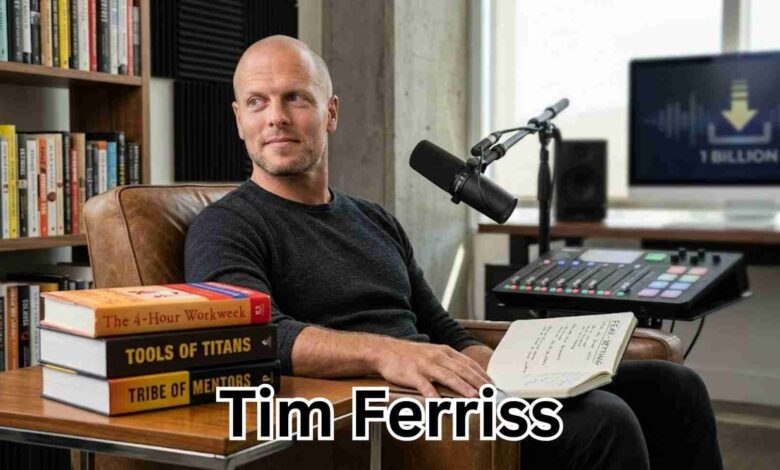
One man’s personal experiments in lifestyle optimization have evolved into a global media empire. Tim Ferriss built his brand on extreme productivity and unconventional career paths. Moving beyond mere hustle, his current trajectory reveals a much deeper focus on well-being. He now prioritizes mental longevity, deliberate living, and psychological health.
This shift mirrors a broader trend among U.S. entrepreneurs looking to build sustainable wealth without sacrificing their minds. This breakdown explores how to apply his core principles right now. You will learn actionable strategies from The 4-Hour Workweek and discover the modern frameworks he shares on his podcast to help you reclaim your time.
Who is Tim Ferriss? The Rise of a Productivity Guru
Before he became a household name in American business, he was a stressed entrepreneur trying to escape his own company. His early life set the stage for a radical approach to work.
From Princeton to Silicon Valley
According to his 2026 biographical data on Wikipedia’s Tim Ferriss Biography, he graduated from Princeton University in 2000 with a B.A. in East Asian studies. He did not step into an immediate success story. After graduation, he moved to Silicon Valley and entered the grueling world of tech sales.
He eventually started his own sports nutrition company called BrainQUICKEN. The business grew, but it demanded 14-hour workdays. He experienced severe burnout and realized he was trapped in a high-paying prison of his own making. This breaking point forced him to rethink traditional corporate models entirely. He took a sabbatical to Europe and South America to rebuild his operating system from scratch.
The 4-Hour Workweek Phenomenon
In 2007, The 4-Hour Workweek hit the shelves and completely disrupted the American corporate mindset. Inc. Magazine’s retrospective on The 4-Hour Workweek confirms the book introduced concepts like passive income and lifestyle design to a mainstream audience. The book stayed on the New York Times bestseller list for over four years and was translated into 40 languages.
He challenged the concept of deferred living. He argued against working 40 years just to enjoy a brief retirement. Instead, he proposed taking “mini-retirements” throughout your life.
My Pro Tip: The Evolution of Outsourcing
In 2007, Ferriss heavily advocated for hiring overseas virtual assistants to handle administrative tasks. For modern U.S. professionals in 2026, the strategy remains the same, but the tool has changed. Instead of immediately hiring a human assistant for basic tasks, leverage AI agents first. You can automate scheduling, data entry, and basic research with AI tools at a fraction of the cost. Reserve human assistants for complex, high-leverage operations.
The Tim Ferriss Show: 1 Billion Downloads and Counting
Writing books gave him a platform, but audio made him an institution. He launched his podcast as a short-term experiment. It quickly became an indispensable resource for the business community.
Deconstructing World-Class Performers
The Tim Ferriss Show launched as a pioneer in long-form interviewing. It quickly became the premier business podcast in the United States. According to verified 2026 data from The Blog of Author Tim Ferriss, the show has officially surpassed one billion total downloads.
He interviews top performers across various fields. Guests range from chess champions and hedge fund managers to military generals and Hollywood actors. The goal is always to extract replicable routines, favorite books, and specific tactics that listeners can test in their own lives.
Key 2026 Podcast Themes: Mental Health & Simplicity
Early episodes focused heavily on physical biohacking and aggressive wealth accumulation. Recent years show a distinct pivot toward inner peace. His 2025 and 2026 content themes center around radical simplicity and mental health advocacy.
He frequently explores Stoicism on the podcast. He references philosophers like Seneca and Marcus Aurelius to help listeners manage anxiety and build emotional resilience. He actively encourages reducing digital noise and prioritizing psychological well-being over relentless financial scaling.
Tim Ferriss Books: The “4-Hour” Empire & Beyond
He treats his book projects as massive, immersive experiments. Each publication serves as a deep dive into a specific area of lifestyle optimization.
The 4-Hour Body & The 4-Hour Chef
Following his initial success, he applied his optimization frameworks to the human body. The 4-Hour Body tackles rapid fat loss, muscle gain, and better sleep through unconventional methods. He tested hundreds of protocols to find the minimum effective dose for physical transformation.
The 4-Hour Chef followed shortly after. It disguises itself as a cookbook. In reality, it is a comprehensive guide to meta-learning. He uses cooking to teach readers how to deconstruct and master any complex skill quickly.
Tools of Titans & Tribe of Mentors
He later shifted from writing about his own experiments to synthesizing the wisdom of his podcast guests.
| Book Title | Core Concept | Target Audience |
| Tools of Titans | Deconstructed habits of billionaires and icons | High achievers seeking daily routines |
| Tribe of Mentors | Short, tactical advice from 100+ experts | Professionals facing career crossroads |
Tools of Titans categorizes world-class habits into three sections: Healthy, Wealthy, and Wise. Tribe of Mentors followed a similar format. He reached out to highly successful people with a standardized set of questions to extract practical life advice.
Angel Investing and Silicon Valley Influence
Before he was a globally recognized author, he established a formidable track record in finance. He leveraged his network to gain access to highly competitive funding rounds.
The Early-Stage Tech Investor
He is recognized as one of the most successful angel investors of his generation. Tim Ferriss’s official investment portfolio on tim.blog confirms he served as an early investor or advisor to massive technology companies.
His portfolio includes Uber, Facebook, Shopify, Duolingo, and Alibaba. He successfully identified consumer trends and platform shifts long before they hit the mainstream U.S. market. He often worked directly with founders like Kevin Rose to refine product launches.
Funding Psychedelic Research
His investment strategy has radically shifted over the past decade. He stepped back from Silicon Valley tech startups to focus almost entirely on philanthropic efforts.
He is now a major financial backer of clinical psychedelic research. He funds studies at top-tier U.S. medical institutions, including Johns Hopkins University. These studies focus on the efficacy of compounds like psilocybin in treating severe depression, addiction, and trauma. He views this as the most high-leverage way to reduce human suffering at scale.
Applying the Tim Ferriss Philosophy in 2026
Reading about his life is interesting, but applying his frameworks is where the real value lies. You can implement his core methodologies immediately.
The DEAL Formula Today
The core framework of The 4-Hour Workweek is the DEAL formula. It stands for Definition, Elimination, Automation, and Liberation.
-
Definition: Set exact goals and calculate the precise monthly cost of your ideal lifestyle.
-
Elimination: Remove time-wasting activities using the 80/20 rule. Focus only on the 20 percent of actions driving 80 percent of your results.
-
Automation: Build systems to handle repetitive tasks without your direct involvement.
-
Liberation: Remove geographical constraints, allowing you to work from anywhere.
In a post-2020 remote work environment, the Liberation step is easier than ever. The focus for professionals today must remain heavily on Elimination.
Fear-Setting: A Modern Step-by-Step Guide
Goal-setting often fails because it ignores underlying anxieties. Fear-setting is a practical exercise derived from Stoicism designed to overcome this paralysis. You can apply this framework to any major career decision right now.
-
Define the Nightmare: Write down the absolute worst things that could happen if you take this step. Be incredibly specific about the financial and social fallout.
-
Identify Prevention Strategies: List exactly what you can do to prevent these worst-case scenarios from occurring.
-
Determine Repair Actions: If the worst does happen, write down exactly how you would fix it or who you could ask for help.
-
Measure the Upside: Outline the exact benefits of an attempt or partial success.
-
Calculate the Cost of Inaction: Write down the emotional, physical, and financial cost of doing nothing for the next six months, one year, and three years.
When you put your fears on paper, you usually realize the worst-case scenario is temporary and reversible.
Frequently Asked Questions About Tim Ferriss
What does Tim Ferriss do for a living?
He is a full-time author, podcaster, early-stage technology investor, and philanthropist. He focuses the majority of his current time on podcasting and funding medical research.
How did Tim Ferriss make his money?
He built his initial wealth by founding and scaling a sports nutrition company called BrainQUICKEN. He subsequently generated significant revenue through his bestselling books and highly lucrative angel investments in companies like Uber and Shopify.
What is Tim Ferriss’s net worth?
While exact private figures are not publicly disclosed, conservative estimates place his net worth in the tens of millions of dollars. The vast majority of this stems from early equity in major Silicon Valley tech unicorns.
Is The 4-Hour Workweek still relevant today?
Yes. While specific tools mentioned in 2007 are outdated, the core framework remains highly effective. The principles of the 80/20 rule, asynchronous communication, and remote work are more applicable now than they were at publication.
What is Tim Ferriss famous for?
He is most famous for popularizing the concept of lifestyle design through The 4-Hour Workweek. He is also known for pioneering the long-form business interview format with The Tim Ferriss Show.
Conclusion
Tim Ferriss built his early reputation on extreme time-management and hacking physical productivity. Today, his influence stems from his willingness to evolve publicly. He shifted the conversation from working fewer hours to doing work that actually matters.
The ultimate optimization hack is not doing more things in less time. It is relentlessly identifying what to eliminate completely. Pick one major decision you have been avoiding and run it through the fear-setting exercise this week. Alternatively, subscribe to his “5-Bullet Friday” newsletter to see what tools and strategies he uses right now.