Lucy Worsley: How 21 Years as a Curator Shaped Her TV
Lucy Worsley Spent 21 Years Running Royal Palaces Before She Became a TV Historian — That Order Matters
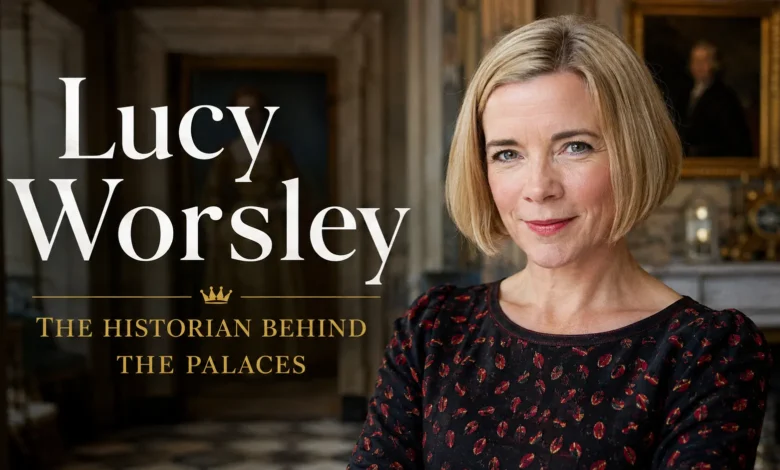
Most profiles of Lucy Worsley open with the coat, or the hair clip, or the speech impediment. Few mention that before she was explaining Henry VIII to a BBC Two audience, she spent her days deciding how to preserve his palaces, and that the two jobs, done back to back for two decades, are not as separate as they look.
Who is Lucy Worsley, in short? She’s an English historian, author and television presenter, born 18 December 1973 in Reading, who served as joint chief curator at Historic Royal Palaces from 2003 until stepping down at the end of 2024, and who has presented BBC and Channel 5 documentaries since 2011, including Six Wives, Agatha Christie: A Very Elusive Woman, and Lucy Worsley Investigates.
Key Facts
| Born | 18 December 1973, Reading, Berkshire |
| Education | BA (First), Ancient and Modern History, New College, Oxford (1995); DPhil, University of Sussex (2001) |
| Curatorial career | Historic Royal Palaces, joint chief curator, 2003–2024 |
| Honour | OBE, 2018 Birthday Honours, for services to history and heritage |
| Married | Architect Mark Hines, November 2011 |
| Forthcoming | Memoir of her HRP years, due autumn 2026 (per her talent agency) |
The job before the job
Before any of the television work, there was a fairly ordinary curatorial career doing fairly unglamorous things. Worsley’s first job, in the summer of 1995, was as a historic house curator at Milton Manor near Abingdon. From 1996 to 2002 she worked as an inspector of historic buildings for English Heritage in the East Midlands, where she got interested in William Cavendish, 1st Duke of Newcastle, and ended up writing the English Heritage guidebook to his home, Bolsover Castle in Derbyshire. That interest didn’t stay a side project, it became her doctoral thesis at Sussex, completed in 2001, and later the raw material for her first book, Cavalier: A Tale of Chivalry, Passion and Great Houses, published in 2007.
That’s a slower, more academic route into public life than most television presenters take, and it shows up in the finished programmes. After a stint managing major projects for Glasgow Museums in 2002–03, she moved to Historic Royal Palaces as chief curator, the charity responsible for the Tower of London, Hampton Court, Kensington Palace’s state apartments, the Banqueting House and Kew Palace. She stayed there for 21 years, overseeing among other things a £12 million refurbishment of the Kensington Palace state apartments and gardens, completed in 2012.
Why this is the angle worth telling
Her talent agency, KBJ Management, puts it plainly on her client page: her training as a professional curator “colours her broadcasting,” which they describe as “immersion in primary sources and the fabric of day-to-day life.” That’s not agency flattery so much as a fair description of what actually distinguishes her programmes from the standard talking-heads-and-archive-footage format. When she stepped into the role of a lady-in-waiting for Six Wives with Lucy Worsley, or reframed Henry VIII’s court through health and sexuality in Tales from the Royal Bedchamber, she was doing something closer to museum interpretation than conventional presenting, using physical objects and spaces to make an argument, rather than narrating over them.
It’s a throughline you can trace across fifteen years of commissions: If Walls Could Talk (2011) used the history of the home itself as the narrative device; A Very British Murder (2013) treated Victorian crime reporting as a primary source in its own right; Jane Austen: Behind Closed Doors (2017) and her Agatha Christie documentary and biography both worked the same way, reconstructing a life through its material remains rather than just its dates. This is what the curator-turned-broadcaster route actually produces, and it’s largely absent from how she’s written about online, where the focus tends to land on her marital status or her wardrobe instead.
The exit, and what comes next
In October 2024, Worsley announced she was stepping down from Historic Royal Palaces at the end of that year, saying she wanted to focus on her BBC Radio 4 podcast Lady Killers, which was named one of the BBC’s most-downloaded podcasts in both 2022 and 2024. According to her agency’s own client page, she has a memoir of her HRP years scheduled for publication in autumn 2026, alongside a new BBC Two crime series, Lucy Worsley: Victorian Murder Club, which reopens the case of the Thames Torso Murders. Her Instagram bio, meanwhile, still describes her as an “Ambassador” for the Historic Royal Palaces charity, suggesting the relationship has shifted rather than ended outright, though the exact nature of that ongoing role isn’t detailed in any source I could verify.
That 2026 memoir is, as far as the available sources show, the first time she’ll have written directly about the institution that shaped her television career, rather than about the historical subjects that institution let her access. It’s a natural closing chapter to the curator story, and one that’s had almost no press coverage so far.
What’s confirmed vs. what’s often claimed but unverified
Confirmed, and traceable to named sources:
- Her academic and curatorial timeline (Wikipedia, citing contemporary press and BBC profile pages)
- Her OBE, awarded in the 2018 Birthday Honours (Wikipedia, BBC News, IMDb)
- Her marriage to Mark Hines in November 2011 (Wikipedia, IMDb)
- Her 21-year tenure at Historic Royal Palaces and 2024 departure (Wikipedia, KBJ Management)
Widely claimed but not verifiable from primary sources:
- Net worth. Several low-authority sites estimate figures ranging from $1 million to $5 million, with no consistent methodology or sourcing between them. None of this traces to a filing, interview, or official statement. Verified data not available.
- Exact current age. Wikipedia’s infobox calculates 52 (as of 2026); IMDb’s automated FAQ box, evidently not refreshed since her most recent birthday, still says 51. Her birth date itself, 18 December 1973, is consistent across sources.
- A relation to Katharine, Duchess of Kent. This is a genuine, recurring point of confusion in search results, not a fabricated rumour: the late Duchess of Kent (1933–2025) was born Katharine Lucy Mary Worsley. The shared surname and a shared first name are coincidental, nothing in the record connects the two women, and the historian Lucy Worsley has publicly denied any relation.
The bottom line
The public image of Lucy Worsley, the coat, the rhotacism, the “childless by choice” line she’s had to keep clarifying, tends to flatten a career that was built the slow way, through two decades of curatorial work most viewers never saw. The palaces came first. The programmes were, in a real sense, a way of taking the public into rooms she’d already spent years working to understand. Her 2026 memoir looks likely to be the first place she tells that part of the story directly.
Sources
- Wikipedia, “Lucy Worsley”, https://en.wikipedia.org/wiki/Lucy_Worsley
- KBJ Management, official client/talent agency page, https://kbjmanagement.co.uk/clients/lucy-worsley
- IMDb, official credits and personal data page, https://www.imdb.com/name/nm3917687/
- Official site, https://www.lucyworsley.com/
- BBC-sourced programme data for Lucy Worsley Investigates (Series 1 & 2 episode listings, via BBC-syndicated schedule data on PBS Pressroom and TheTVDB, as direct BBC iPlayer access was blocked at time of research)
- Wikipedia, “Katharine, Duchess of Kent” (for mistaken-identity clarification), https://en.wikipedia.org/wiki/Katharine,_Duchess_of_Kent