
Trading for Beginners: Avoid These UK First-Trade Traps
FCA checks, tax rules and risks before your first trade
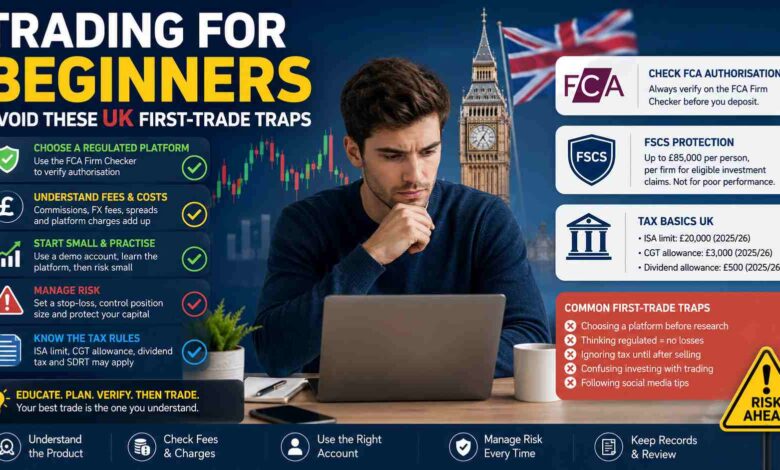
Trading for beginners can look simple when a mobile app lets you open an account in minutes. The real risk is what happens before the first trade: choosing the wrong product, missing fees, ignoring tax, or trusting a platform you have not checked.
That matters in the UK because trading apps are now part of mainstream retail investing. FCA 2025 data from its Financial Lives 2024 survey says 3% of UK adults, around 1.6 million people, were using a trading app. Almost half of those users, 47%, were aged 18 to 34.
This guide explains how trading works, how to check an FCA regulated trading platform, what UK beginners should know about share dealing, tax, FSCS protection and first-trade risk.
This is educational information, not personal financial advice.
Table of Contents
ToggleWhat Is Trading for Beginners in the UK?
Trading explained in plain English
Trading means buying and selling financial products to try to profit from price movements.
A beginner might buy a share because they think the price will rise. Another trader might use a derivative, such as a CFD or spread bet, to speculate on price changes without owning the underlying share.
That second route carries more risk. A beginner should know the difference before depositing money.
Common products include:
| Product | What it means | Beginner risk level |
|---|---|---|
| Individual shares | You buy part ownership in a company | Medium to high |
| ETFs | A fund traded on an exchange | Medium |
| Investment funds | A pooled investment managed by a provider | Medium |
| Forex | Trading currency pairs | High |
| CFDs | Speculating on price movement without owning the asset | High |
| Spread betting | Tax-treatment can differ, but risk remains high | High |
MoneyHelper, backed by government through the Money and Pensions Service, groups common investments into asset classes such as shares, cash, property and fixed interest securities. It also says investments can produce returns through dividends, interest, rent, or capital gains and losses.
MoneyHelper beginner investing guide
Trading vs investing: which one fits a beginner?
Trading and investing are not the same thing.
| Point | Trading | Investing |
|---|---|---|
| Timeframe | Shorter term | Usually longer term |
| Goal | Profit from price moves | Build wealth over time |
| Activity level | More active | Less active |
| Risk | Often higher | Varies by asset |
| Skill needed | Market timing, discipline, risk control | Asset choice, patience, diversification |
A beginner often starts with the word “trading” but really needs to decide whether they mean active trading or long-term investing.
MoneyHelper says if a savings goal is more than five years away, investing some cash may help money go further and keep up with rising prices. It also makes clear there is no such thing as a no-risk investment.
What can UK beginners trade?
UK beginners can access many products through trading apps and online brokers. These may include shares, ETFs, funds, fractional shares, FX, options, CFDs, ISAs and SIPPs.
The FCA’s 2025 review of trading apps found that apps give retail investors easier access to a wider range of investments. It also warned that some apps offer higher-risk investments that were traditionally aimed at wholesale markets.
That is the key lesson. Access does not mean suitability.
How Trading for Beginners in the UK Should Start Safely
Step 1: Decide whether you should trade or invest first
Before opening a trading account, ask five basic questions:
- Do I have emergency savings?
- Do I have high-interest debt?
- Can I leave this money invested for years?
- Can I afford to lose the amount I trade?
- Do I understand the product I am buying?
If the answer to those questions is weak, active trading may not be the right first step.
Common mistake: Many beginners choose a trading app before deciding whether they should be trading at all.
Step 2: Learn the product before funding an account
Do not fund an account just because the app looks easy.
Learn what each product does first. Shares, ETFs, CFDs, spread betting and forex do not behave the same way. They also do not carry the same fees, tax treatment or downside risk.
A simple rule helps:
If you cannot explain how the product makes or loses money, do not trade it yet.
Step 3: Practise with a demo account before real money
A demo account lets you practise placing trades without risking real money. It will not fully copy the emotions of real trading, but it helps you learn the platform.
Use it to practise:
- Searching for a share or ETF
- Placing a buy order
- Setting a stop-loss
- Reading fees
- Closing a position
- Recording why you entered and exited
Step 4: Start small and set a maximum loss
Your first real trade should not test your courage. It should test your process.
Decide the maximum amount you are willing to lose before placing the trade. If the trade would hurt your rent, bills, debt payments or emergency fund, it is not beginner capital.
Common mistake: Beginners often think a small deposit means small risk. That is not always true with leverage, margin, CFDs or spread betting.
Check the FCA Regulated Trading Platform Before You Deposit
How to use the FCA Firm Checker
The FCA Firm Checker is one of the most important tools for UK beginners.
The FCA says consumers can use it to check whether a financial firm is authorised and whether it has permission to provide the services they want.
Use this process:
- Search the firm name on the FCA Firm Checker.
- Check the firm reference number.
- Compare the website, phone number and email details.
- Check what services the firm has permission to provide.
- Be careful of clone firms using similar names.
- Do not rely on links sent by email, advert or social media message.
FCA authorised does not mean risk-free
FCA authorisation reduces some risks. It does not make trading safe.
The FCA says using an authorised firm with correct permissions will greatly reduce the risk of harm, but it will not remove all risk.
That distinction matters. A regulated platform can still offer products that lose money.
Warning signs of trading scams
The FCA says scams can be sophisticated, and fraudsters may use convincing websites and materials that look like the real thing. Warning signs include unexpected contact, pressure to act quickly, promises of high returns, secret offers and emotional manipulation.
Avoid any offer that includes:
- Guaranteed profits
- No-risk trading
- Pressure to deposit today
- A bonus for acting quickly
- Contact through WhatsApp, Telegram or social media
- A firm that tells you not to check the FCA website
MoneyHelper also advises people to avoid unsolicited investment offers, check the FCA Firm Checker and seek regulated financial advice when considering an investment offer.
Trading Apps UK Beginners Should Understand Before Signing Up
Why trading apps feel easy but can still be risky
Trading apps reduce friction. That can be useful, but it can also encourage fast decisions.
The FCA 2025 trading-app review says low or commission-free trading helped attract new retail customers. The same review also notes that trading apps may offer higher-risk investments and that some app features can influence trading behaviour.
That does not mean every app is bad. It means beginners should slow down.
What to compare before choosing a trading app
Do not compare apps only by headline commission.
Compare:
- FCA authorisation
- Product range
- FSCS eligibility
- Account types
- Dealing fees
- FX fees
- Platform fees
- Spreads
- Research tools
- Customer support
- Withdrawal process
- App security
- Complaint process
A good platform for one person may be wrong for another. A beginner buying UK shares in a stocks and shares ISA has different needs from a day trader using CFDs.
Commission-free does not always mean free
“Commission-free” usually means no dealing commission on some trades. It does not always mean the full cost is zero.
Costs may include:
| Cost | Where it can appear |
|---|---|
| FX fee | Buying overseas shares |
| Spread | Difference between buy and sell price |
| Platform fee | Account or service charge |
| Fund charge | ETF or fund ongoing cost |
| SDRT | Some UK share purchases |
| Withdrawal fee | Moving cash out |
| Subscription fee | Premium app tiers |
The FCA 2025 review says trading apps can generate revenue through transaction fees, subscription fees and interest earned from cash balances. It also notes that FX transaction fees are generally applied where trades involve overseas investments.
Share Dealing UK: Accounts, Fees and First-Trade Costs
General Investment Account vs Stocks and Shares ISA vs SIPP
A UK beginner will often see three account types.
| Account type | Basic meaning | Beginner note |
|---|---|---|
| General Investment Account | Flexible taxable investment account | CGT and dividend tax may apply |
| Stocks and Shares ISA | Tax-efficient account for eligible investments | Annual ISA limit applies |
| SIPP | Self-invested personal pension | Pension rules and access limits apply |
The GOV.UK Budget 2025 rates and allowances page lists the ISA subscription limit as £20,000 for tax year 2025 to 2026 and £20,000 for tax year 2026 to 2027.
Dealing fees, platform fees and FX charges
Fees reduce returns. That sounds obvious, but beginners often ignore small charges until they add up.
| Fee type | What it means | Why it matters |
|---|---|---|
| Dealing fee | Cost to buy or sell | Frequent trades can increase costs |
| Platform fee | Account or service fee | Can apply even when you do not trade |
| FX fee | Currency conversion fee | Common with US shares |
| Spread | Buy price differs from sell price | Hidden cost on every trade |
| Fund charge | Ongoing ETF or fund cost | Reduces long-term returns |
MoneyHelper says investment fees can eat into returns and are something to ask about before investing.
Stamp Duty Reserve Tax on UK shares
GOV.UK says when you buy shares, you usually pay a tax or duty of 0.5% on the transaction. If you buy shares electronically, you pay Stamp Duty Reserve Tax. If you buy shares using a stock transfer form, Stamp Duty applies if the transaction is over £1,000.
This is why a beginner should understand the full cost before placing a UK share deal.
Capital Gains Tax on Shares UK: What Beginners Must Know
Stocks and Shares ISA allowance
A stocks and shares ISA can be useful because eligible returns inside the ISA are generally sheltered from UK tax.
The ISA subscription limit is £20,000 for 2025 to 2026 and £20,000 for 2026 to 2027, according to GOV.UK Budget 2025 rates and allowances.
Tax rules can change. Your personal circumstances also matter.
Capital Gains Tax allowance and rates
If you sell investments outside an ISA or pension, Capital Gains Tax may apply.
GOV.UK lists the annual exempt amount for individuals as £3,000 for 2025 to 2026 and £3,000 for 2026 to 2027.
GOV.UK Budget 2025 also lists CGT rates for gains on assets other than residential property and carried interest as 18% for basic-rate taxpayers and 24% for higher-rate taxpayers for 2025 to 2026 and 2026 to 2027.
GOV.UK Capital Gains Tax rates and allowances
Dividend allowance and dividend tax
Dividends can also matter if you own shares or funds outside an ISA or pension.
GOV.UK Budget 2025 lists the dividend allowance as £500 for 2025 to 2026 and £500 for 2026 to 2027. It also lists dividend ordinary, upper and additional rates for those tax years.
Keep records of:
- Buy date
- Buy price
- Sell date
- Sell price
- Fees
- Dividends received
- Account type
When to consider professional tax advice
Get professional tax advice if you trade often, hold overseas shares, receive large dividends, use complex products, or are unsure how gains apply to your tax position.
GOV.UK also says people can get professional help, for example from a tax adviser, with share tax questions.
FSCS Protection and What It Does Not Cover
When FSCS may protect investors
FSCS protection is useful, but beginners often misunderstand it.
The FSCS says it can pay up to £85,000 per person, per firm for eligible investment claims. It also says the provider or adviser must have been authorised by the PRA or FCA, and the service and product must have been regulated.
Why FSCS does not cover bad trades
FSCS does not protect you from normal investment losses.
The FSCS clearly says it cannot accept claims for poor investment performance because investments can go down as well as up.
So, if you buy a share and the price falls, FSCS will not refund that loss.
What to check before assuming protection applies
Before relying on FSCS protection, check:
- Is the firm authorised?
- Is the service regulated?
- Is the product covered?
- Is your claim about firm failure or bad advice, not poor performance?
- Does the per-person, per-firm limit apply?
The FCA also warns that the Firm Checker cannot confirm whether FSCS or Financial Ombudsman protection will definitely apply.
Risk Management Basics for New UK Traders
Position size: how much should one trade risk?
Position size means how much money you put into one trade.
A beginner should avoid putting too much into one company, one sector, one theme or one trade idea. Diversification does not remove risk, but it can reduce the damage from one poor decision.
MoneyHelper says spreading money between different asset classes can help lower the risk of a portfolio underperforming.
Stop-loss and take-profit orders
A stop-loss is an instruction to sell if the price falls to a chosen level.
A take-profit order is an instruction to close a trade if the price reaches a chosen profit level.
These tools help with discipline, but they are not magic. In fast-moving markets, a stop-loss may not always execute at the exact price you expected.
Leverage, margin and CFDs
Leverage means controlling a larger position with a smaller deposit. It can magnify gains, but it can also magnify losses.
CFDs and margin trading are not beginner-friendly products. If you do not understand margin calls, overnight funding costs, forced closures and rapid losses, avoid them until you have proper knowledge.
Trading plan checklist
Before placing a trade, write down:
- What am I trading?
- Why am I entering?
- What would prove me wrong?
- Where will I exit?
- What is my maximum loss?
- What fees apply?
- Is there tax to consider?
- Am I using ISA, GIA or SIPP?
- How will I review the trade?
A trading plan will not guarantee profit. It helps stop emotional decisions.
Common First-Trade Traps UK Beginners Should Avoid
Trap 1: Choosing a platform before checking FCA authorisation
Do not rely on adverts, influencer posts or app-store reviews.
Check the firm yourself on the FCA Firm Checker. The FCA says you should confirm the firm reference number and contact details match the details on the Firm Checker.
Trap 2: Thinking “regulated” means “no losses”
Regulation is not a profit shield.
An FCA regulated trading platform can still give access to assets that fall in value. FSCS does not cover poor investment performance.
Trap 3: Ignoring tax until after selling
Beginners often think tax only matters after large profits.
That is risky. Even if your profit is small, you should know whether the trade sits inside an ISA, GIA or pension. You should also know whether CGT, dividend tax or SDRT may apply.
Trap 4: Confusing investing with trading
A long-term investor may buy and hold diversified assets for years. A trader may enter and exit positions much faster.
Neither route guarantees success. The problem begins when a beginner thinks they are investing but behaves like a short-term trader.
Trap 5: Following social media tips without research
A social media tip is not research.
A safer beginner rule is simple: never trade a product because someone else sounds confident. Confidence is not evidence.
What to Do If Something Goes Wrong With a Trading Platform
Complain to the firm first
If something goes wrong, keep records.
Save:
- Account statements
- Trade confirmations
- Emails
- Chat messages
- Screenshots
- Dates and times
- Names of staff you spoke to
Contact the firm and explain the complaint clearly.
When the Financial Ombudsman Service may help
The FCA Firm Checker page says the tool cannot confirm whether Financial Ombudsman protection will definitely apply, and consumers should check what complaints the Financial Ombudsman can help with.
Use this route if you have complained to the firm and still need independent help with an eligible complaint.
Financial Ombudsman Service investment complaints
When FSCS may be relevant
FSCS may become relevant if an authorised firm fails or if there is an eligible investment claim.
It is not there to reverse a bad trade, poor market timing or normal share-price loss.
Before Your First Trade: UK Beginner Checklist
The 10-point first-trade checklist
Use this before funding a trading account or placing your first order.
- I understand the product.
- I checked the firm on the FCA Firm Checker.
- I know whether FSCS may apply.
- I know the platform fees.
- I know the dealing fees.
- I know possible FX or spread costs.
- I know whether I am using an ISA, GIA or SIPP.
- I know possible CGT, dividend tax or SDRT issues.
- I set a maximum loss.
- I know how to complain if something goes wrong.
Trading for beginners should start with this checklist, not with a rushed deposit.
Conclusion
Trading is easier to access than ever, but easy access does not make it low risk.
A UK beginner should understand the product, check the firm on the FCA Firm Checker, compare real fees, know the account type, understand tax basics and avoid assuming FSCS protection covers market losses.
The best first trade is not the one that makes the quickest profit. It is the one you understand before you place it.
Start with research, practise on a demo account, keep your first position small and check the official UK rules before you put real money at risk.
FAQs
How do I start trading as a beginner in the UK?
Start by learning the product, checking the firm on the FCA Firm Checker, comparing fees, choosing the right account type and practising with a demo account. Do not trade money you cannot afford to lose.
What is the best trading platform for beginners in the UK?
There is no single best platform for every beginner. Look for FCA authorisation, clear fees, useful research tools, strong customer support, suitable account types and a product range you understand.
How much money do I need to start trading?
Minimum deposits vary by platform and product. The better question is how much you can afford to risk without affecting bills, debt repayments or emergency savings.
Is trading taxable in the UK?
It can be. Tax depends on your account type, gains, dividends, product and personal circumstances. ISAs can shelter eligible investments, while gains outside an ISA may fall under Capital Gains Tax.
Is trading safe for beginners?
Trading carries risk. FCA authorisation, FSCS eligibility, demo practice, small position sizes and risk management can reduce some risks, but they cannot remove market risk.